Homeschooling in the United States
Tend Wonder makes it easy to homeschool in the United States. This guide covers how the rules work and funding notes nationwide, and links to a guide for each state. Tend Wonder then follows your child’s curiosity and helps you find hands-on ideas, books, resources and nearby experiences in your area. Document your learning together in a Learning Journey, and use Education Coverage to see how your child’s learning connects with educational expectations in your state and what you could explore next. Below, you’ll also find an example of curiosity-led learning.
State rules & funding
Find your homeschooling guide by state.
Homeschooling is allowed in the United States, and each state sets its own rules for giving notice, subjects, records and testing. Funding is decided state by state too: some states offer education savings accounts, scholarships or tax credits that homeschooling families can use, while others offer nothing or limit programs to enrolled students. Each guide covers both, with links to the official sources.
U
A look inside Tend Wonder for the curiosity United States
See how a 9-year-old could explore their curiosity for United States in Tend Wonder. Every family gets suggestions based on their own children’s interests, ages and location.
Your child’s Current Curiosity
United States
Every suggestion below weaves around this curiosity. As your child’s interests evolve, it becomes part of the Learning Journey.
Ideas to Explore
- 01
Build a floor map of U.S. regions
Invite your child to mark a large simple map of the United States on the floor with painter's tape or string. - Make one broad rectangle for the lower 48, then add a small paper label for Alaska and another for Hawaii off to the side. - Let your child place scrap-paper labels for regions they choose to use, such as Northeast, South, Midwest, and West. - Invite them to stand in one region at a time and add one real feature they know belongs there from a map, atlas, or their own knowledge, such as the Great Lakes, the Rocky Mountains, the Gulf Coast, or a desert area. - Ask them to move one label if they change their mind about where a border between regions should go, and tell you what made them revise it. - Keep it broad and approximate; the purpose is comparing parts of the country, not tracing exact state lines. - 02
Compare weather in distant cities
Invite your child to choose three U.S. cities far apart, such as Seattle, Miami, and Minneapolis, and make a one-page weather comparison for today. - Write the city names in three columns. - Let your child look outside in Washington, then use that as a starting guess for which distant city might feel most different today and why. - Invite them to ask for today's temperature and conditions in each city while you provide the numbers. - Let them mark each city with simple symbols such as sun, cloud, rain, wind, or snow, then compare which places are closest in temperature and which are farthest apart. - Ask which pair of cities they would choose if they wanted the most different same-day weather inside one country. - 03
Cook a regional cornbread comparison
Invite your child to make two small bowls of cornbread batter and compare a Northern-style and Southern-style version from the United States. - In one bowl, mix 1/2 cup cornmeal, 1/4 cup whole-wheat flour, 1 egg, 1/3 cup milk or unsweetened plant milk, 1 tablespoon maple syrup, and 1 teaspoon baking powder. - In the second bowl, mix the same amounts without the maple syrup. - You bake both in the same kind of small pan or muffin cups until set. - Let your child compare color, texture, and taste, then decide which version they would serve with soup or chili and why. - Explain afterward that cornbread recipes vary across the United States, including whether they are made sweeter or less sweet. - 04
Hold a state-choice conversation game
Invite your child to choose two U.S. states and defend which one they would rather visit, live in, or road-trip through. - Give simple categories such as weather, distance, coast or inland, mountains or plains, city size, or foods. - Let your child invent the rule for how to decide the winner: more reasons, stronger reason, or one must fit a pretend family plan. - Take the opposite side so they have someone to answer, and switch roles for a second round. - 05
Sketch state outlines for a map check
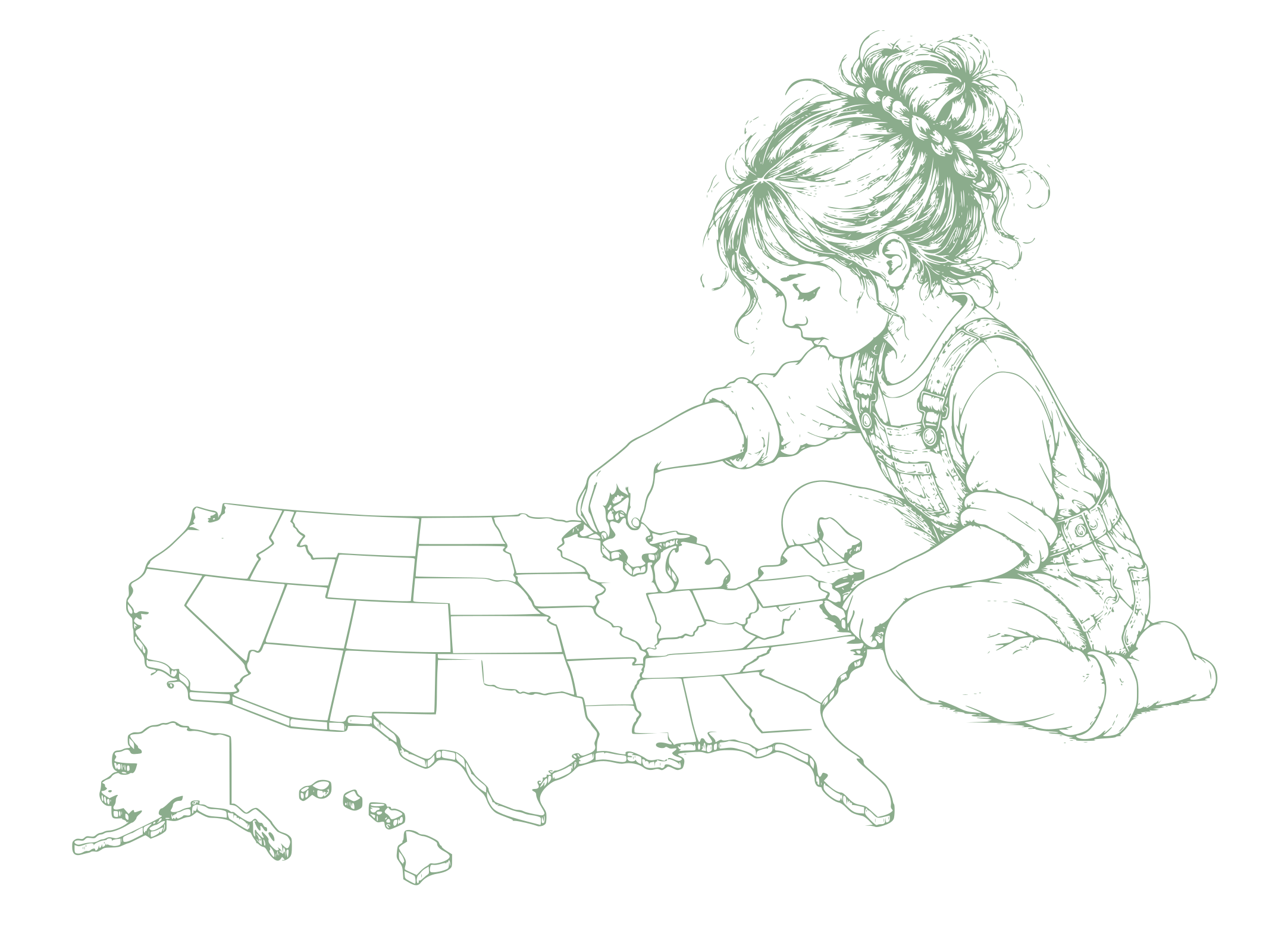
Invite your child to look at a U.S. map or atlas with you and choose five states whose outlines catch their attention. - Let your child sketch each outline on scrap paper, cut them out, and say one feature they notice about each shape, such as a long coast, a straight border, or a corner. - Invite your child to place the cutouts roughly where they think they belong on a blank sheet, then check the map and adjust them. - Ask what helped them place each one: a coast, a border shape, a nearby state, or where it sits in the country. - If they speak Spanish at home, they can label a few in both English and Spanish, such as Texas/Texas or California/California.
Books
Nuestra California
Pam Muñoz Ryan
Nuestra California follows the history and variety of California's cities and towns through rhyming text, offering a look at the state's local heritage and geography.
Los huevos parlantes
Robert D. San Souci
Los huevos parlantes is an adaptation of a Creole folk tale from Louisiana about a girl who meets an old woman with magical eggs that reward her kindness while punishing her sister's greed.
Hacemos mapas de Norteamérica
Emily Jankowski
Hacemos mapas de Norteamérica introduces the geography, climate, and cultures of North America, featuring maps of the United States' Great Plains alongside lessons on reading political and population maps.
Keep Exploring
This resource highlights the diverse ecosystems, cultural regions, and natural landmarks located across the United States. You can compare population totals and land area measurements in the 'Fast Facts' section to see how physical scale differs between the Alaskan tundra and the Florida Everglades. This overview focuses on geographic and biological data.
Explore Nearby
Your child can examine the Greensboro lunch counter section and learn how a protest helped spark a movement to challenge inequality in the United States.
Your homeschool journey starts with their curiosity.
Discover activities, books, and nearby experiences around your child’s interests. Record their learning and see the learning areas they explore along the way.